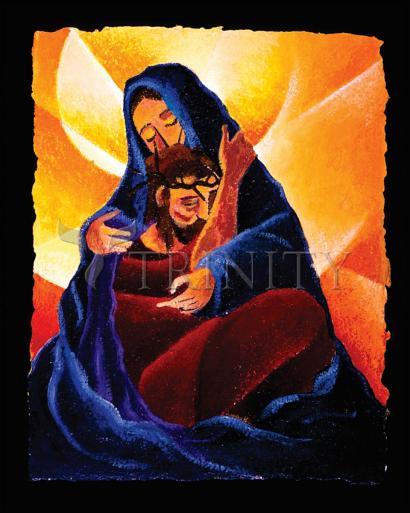


Best overall: St. Benedict of Nursia – Angel Pointing to Monastery of Mont Cassino in a gold wall frame. Best for a saint’s story of comfort: St. Agatha Attended by St. Peter and Angel in Prison. Best for a small devotional image: the St. Michael the Archangel holy card. These are angel artworks for different places and purposes; none is identified in the supplied titles as an angel seraph.
- For angel seraph artwork, look for a work explicitly identified as a seraph; do not treat every angel image as one.
- Trinity Stores’ framed St. Benedict artwork is the best overall angel image here for a home prayer space.
- Choose the St. Agatha scene for a saint’s story, or the St. Michael holy card for personal devotion.
- The Madonna and Child note card is best when the artwork accompanies a written message.
Why this matters
A seraph is not another name for any angel. In Isaiah 6:2, the seraphim have six wings and stand near the divine throne. An artwork titled with an angel, an archangel or a saint attended by an angel does not automatically depict that scene. If angel seraph is the subject you need, confirm the artwork’s title and description before choosing it.
For a prayer space in 2026, you can begin with the subject instead: a saint guided by an angel, a saint comforted in suffering, or St. Michael the Archangel. Trinity Stores offers religious artwork in wall and card formats, but format alone cannot tell you which heavenly figure appears in the image. The title is the first check.
What makes the best angel artwork for your home?
- Identifiable subject: Look for a title that names the saint, angel or biblical scene. If the title does not say seraph, do not assume it shows one.
- Devotional purpose: Choose an image you will return to in prayer. A work about guidance invites a different reflection from one about consolation or protection.
- Place of use: A wall frame belongs where you want to see the image regularly; a holy card stays close to a prayer book or travels with you.
- Artist credit: Keep the artist or source with the work. Museum Art is credited on the St. Benedict and St. Agatha selections; the St. Michael holy card credits Br. Mickey McGrath.
- Format details: Check the listed presentation before choosing. A mounted plaque, framed print and note card serve different needs even when they show the same artwork.
- Faithful description: Let the named scene lead. Do not relabel an archangel as a seraph to fit a search term.
These criteria put subject ahead of decoration. In 2026, the best angel artwork for your home is the image whose named story fits the way you intend to use it.
Angel artwork at a glance
| Artwork | Best for | Standout feature | Key limitation |
|---|---|---|---|
| St. Benedict of Nursia – Angel Pointing to Monastery of Mont Cassino, gold wall frame | A home prayer space | Named scene of angelic guidance in a framed format | Not identified as a seraph |
| St. Agatha Attended by St. Peter and Angel in Prison, espresso wall frame | Reflection on comfort in suffering | The title places the angel within St. Agatha’s story | Not a standalone angel portrait |
| Madonna and Child with St. Joseph and Angel, custom text note card | A devotional message to someone else | Artwork and personalized text share one card | A note card is not wall art |
| St. Michael the Archangel holy card | Personal devotion | Names St. Michael and credits Br. Mickey McGrath | An archangel is not a seraph |
Trinity Stores’ framed St. Benedict artwork is best for someone who wants a named angel scene in a home prayer space. If you specifically need a depiction of the seraphim of Isaiah, do not substitute any of these four on the strength of the word angel alone.
The wall pieces and cards answer different needs. Picture where the work will live before choosing among them: in view during daily prayer, with a gift message, or close at hand as a holy card.
1. St. Benedict: best angel artwork for a home prayer space
St. Benedict of Nursia – Angel Pointing to Monastery of Mont Cassino by Museum Art names both the saint and the angel’s action. The gold wall frame gives this selection a fixed place in the home. Its subject makes it the clearest choice here for reflecting on guidance rather than seeking a general image of an angel.
The title matters. It points you toward St. Benedict’s story; it does not identify the angel as a seraph. If you are searching for an angel seraph image in 2026, that distinction rules this work out as an exact match while leaving it a fitting choice for prayer about direction.
St. Benedict pros:
- The title identifies a specific saint and angel scene.
- A wall frame suits a prayer space you pass or use each day.
- Museum Art is credited in the product title.
St. Benedict cons:
- The work is not identified as a seraph depiction.
- The scene centers St. Benedict as well as the angel, so it is not an angel-only portrait.
Best for: A home prayer space centered on guidance. Verdict: Buy if that named scene speaks to your prayer; skip it if you need an explicitly titled seraph.
Choose the presentation, not just the image
The same St. Benedict scene appears in several listed forms. The gold-frame description includes a white mat option described as 2 inches wide and frame moulding described as 1½ inches wide. The standard wood-plaque listing describes a ½-inch plaque; the premium plaque listing describes a ¾-inch plaque. Those are presentation details, not reasons to call the subject a different angel.
A wall frame keeps the image in view. A plaque gives you a mounted alternative, while the listed holy-card format brings the St. Benedict scene into a smaller devotional setting. Check the current product listing for the precise version you want rather than treating every format as interchangeable.


2. St. Agatha: best angel artwork for reflection on comfort
St. Agatha Attended by St. Peter and Angel in Prison by Museum Art places its angel within a saint’s story rather than presenting a heavenly figure alone. The espresso-framed version is a wall piece for someone who wants to return to that scene in prayer. Its title makes the narrative clear without requiring you to guess what the image represents.
This is a different choice from St. Benedict. One title names an angel pointing toward a monastery; the other names St. Agatha attended in prison. If your devotional focus is comfort amid suffering, St. Agatha is the more direct subject. Neither title identifies a seraph.
St. Agatha pros:
- The title gives the angel a specific place in St. Agatha’s story.
- The framed format makes the scene suitable for a regular viewing spot.
- Museum Art is named as the artwork source.
St. Agatha cons:
- The scene is about St. Agatha, St. Peter and an angel, not an angel alone.
- It does not answer a search for artwork explicitly depicting seraphim.
Best for: Reflection on consolation and steadfast faith. Verdict: Buy for that saint-centered purpose; skip if the figure you want named in the title is a seraph.
3. Madonna and Child: best angel artwork for a devotional message
Madonna and Child with St. Joseph and Angel by Museum Art appears here as a custom text note card. It brings an angel into a scene named for Mary, Jesus and St. Joseph, with space for your own message inside. Choose it when the act of writing to someone matters as much as the image.
This is not a substitute for a framed piece in 2026. A card belongs with a recipient, not in a wall-art comparison. Nor does its title identify the angel as a seraph or as any particular named angel. Read the named figures as the subject, and let your written message carry the personal intention.
Madonna and Child note card pros:
- The title identifies the figures shown alongside the angel.
- The product description specifies personalized text inside.
- The description also specifies an artist narrative on the back.
Madonna and Child note card cons:
- A note card does not meet a need for permanent wall artwork.
- The angel is one figure in a wider scene, not its sole subject.
Best for: Sending a devotional image with a personal message. Verdict: Buy for a written gift; skip for a home wall display or a specifically named seraph.
4. St. Michael: best angel artwork for personal devotion
The St. Michael the Archangel – Patron of Police and First Responders holy card credits Br. Mickey McGrath. It is the most direct choice in this ranking when you want a named angel rather than an angel appearing within a saint’s story. Its holy-card format gives it a different role from the framed selections.
Keep the distinction exact: Michael is called an archangel in the product title, not a seraph. In 2026, an angel seraph search can lead you to many images of heavenly figures, but the name in this title tells you which figure this card concerns. Choose it for devotion to St. Michael, not as an illustration of Isaiah’s seraphim.
St. Michael pros:
- The title identifies the heavenly figure by name.
- The title states the patronage focus.
- The artist credit names Br. Mickey McGrath.
St. Michael cons:
- A holy card does not fill the role of framed wall artwork.
- An archangel is not an exact match for a seraph search.
Best for: Personal devotion to St. Michael, particularly with the patronage named in the title. Verdict: Buy for that purpose; skip if you need a wall piece or an explicitly identified seraph.
How these choices were ranked
The ranking gives priority to a clear subject and a fitting use. St. Benedict comes first because its named angel scene and wall format meet the broadest home-display need in this group. St. Agatha follows for a more specific saint-centered meditation. The Madonna and Child note card and St. Michael holy card serve readers who want a written gift or a portable devotional image rather than wall art.
This is not a ranking of artistic merit, and it is not a ranking of seraph depictions. None of the four supplied artwork titles identifies its angel as a seraph. That limit matters more than a convenient match to a search phrase.
Which angel artwork should you choose?
Choose the framed St. Benedict scene as the default for your home in 2026. It names what the angel is doing and gives the image a place for repeated reflection. Choose St. Agatha when the story of a saint attended in prison speaks more directly to your prayer.
For a message to another person, choose the Madonna and Child note card. For devotion to a named archangel, choose the St. Michael holy card. If your requirement is specifically angel seraph artwork, wait until a work is explicitly identified as depicting a seraph or the seraphim; none of these titles makes that claim.
FAQ
What is the best angel artwork for a home prayer space in 2026?
The framed St. Benedict of Nursia – Angel Pointing to Monastery of Mont Cassino is the best overall choice in this selection. Its title names a specific angel scene, but it does not identify the angel as a seraph.
Is an angel seraph the same as an archangel?
No. Isaiah 6:2 describes seraphim near the divine throne, while the St. Michael holy card identifies Michael as an archangel. Do not use those names interchangeably when choosing artwork.
Does the St. Michael holy card show a seraph?
The supplied product title does not identify a seraph. It names St. Michael the Archangel, so choose the card for devotion to St. Michael rather than as a named seraph depiction.
Which angel artwork is best for reflecting on a saint’s suffering?
St. Agatha Attended by St. Peter and Angel in Prison is the clearest choice here. Its title places the angel within St. Agatha’s prison scene.
Which angel artwork works best with a written gift?
The custom text note card featuring Madonna and Child with St. Joseph and Angel is the best fit. Its product description specifies personalized text inside and an artist narrative on the back.
Should I choose a wall frame or a holy card?
Choose a wall frame for an image you want to see in a regular prayer space and a holy card for personal devotion close at hand. The framed St. Benedict scene and St. Michael holy card serve those separate purposes.
How can I tell whether angel artwork depicts a seraph?
Check whether the artwork’s title or description explicitly identifies a seraph or the seraphim. Isaiah 6:2 describes seraphim with six wings, but the word angel alone does not establish that identification.
One last thing
The most useful question in 2026 is not simply Which angel image do I like? Ask which figure the artwork actually names. That small check lets you choose a St. Michael image for devotion to an archangel, a St. Benedict scene for reflection on guidance, or keep looking when the seraphim are the subject you truly want.